A Global Assessment of Dugong’s Body Condition Based on Drone Footage
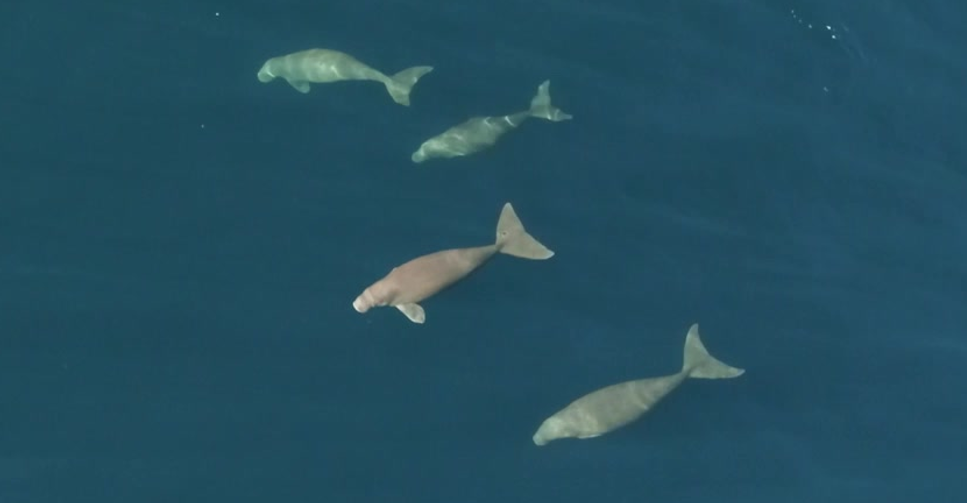
Abu-Dhabi, 19 September 2025 - For the first time, an international study published in Remote Sensing in Ecology and Conservation used drone footage to investigate the dugong’s body condition across the Indo-Pacific Ocean.
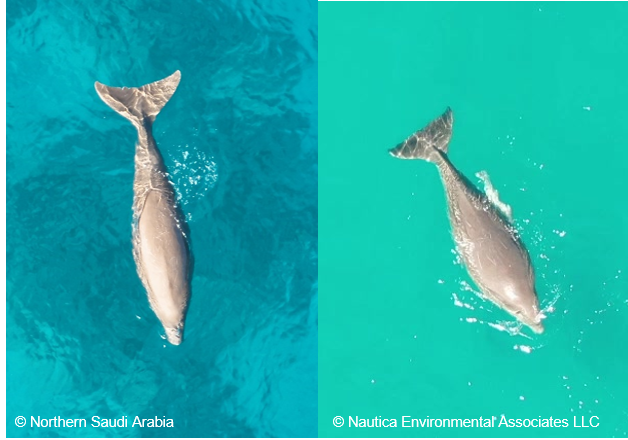
Contrasting body condition of dugongs assessed by drone. The left individual was spotted off the Saudi Arabian coast in the Red Sea. It is comparatively skinnier than the right individual, sighted off the United Arab Emirates in the Persian Gulf.
An animal's body condition is a good indicator of its health: a “plump” individual being healthier than a “skinny” one. Thus, the presence of plump versus skinny individuals can reflect a population’s health state, helping researchers and managers in assessing its conservation status.
For the first time, this international study led by French Institut de Recherche pour le Développement investigated the body condition of the dugong across its Indo-Pacific range.
To do so, the authors applied the body condition index developed for the related Antillean manatee based on length and width measurements of individuals captured in drone footage.
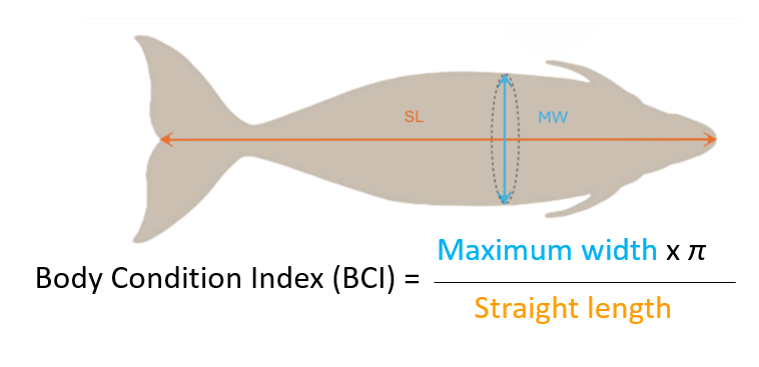
Illustration of the body condition index based on dugong measurements from drone footage, as initially applied to the Antillean manatee (Ramos et al. 2022)
Using images collected by scientific surveys combined with images gathered on social media like Youtube and Instagram, they measured 272 dugongs across 18 countries.
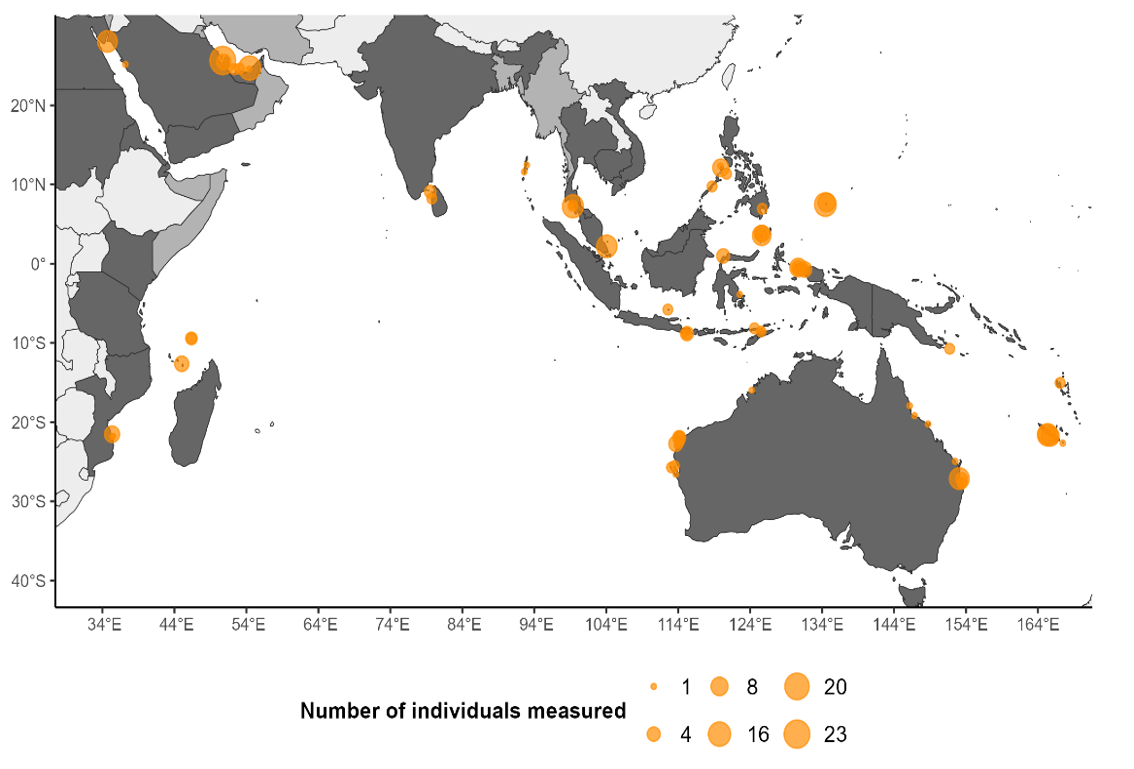
Geographic locations of individual dugongs measured from drone footage. Countries with confirmed resident populations and unconfirmed populations (Marsh et al., 2024) are shown in dark grey and light grey, respectively. Countries where the dugong is not present are shown in lightest grey.
The results show that dugongs from the largest known populations like in Australia and the United Arab Emirates were “plumper” than dugongs from small, endangered populations, such as in Mozambique and Palau.
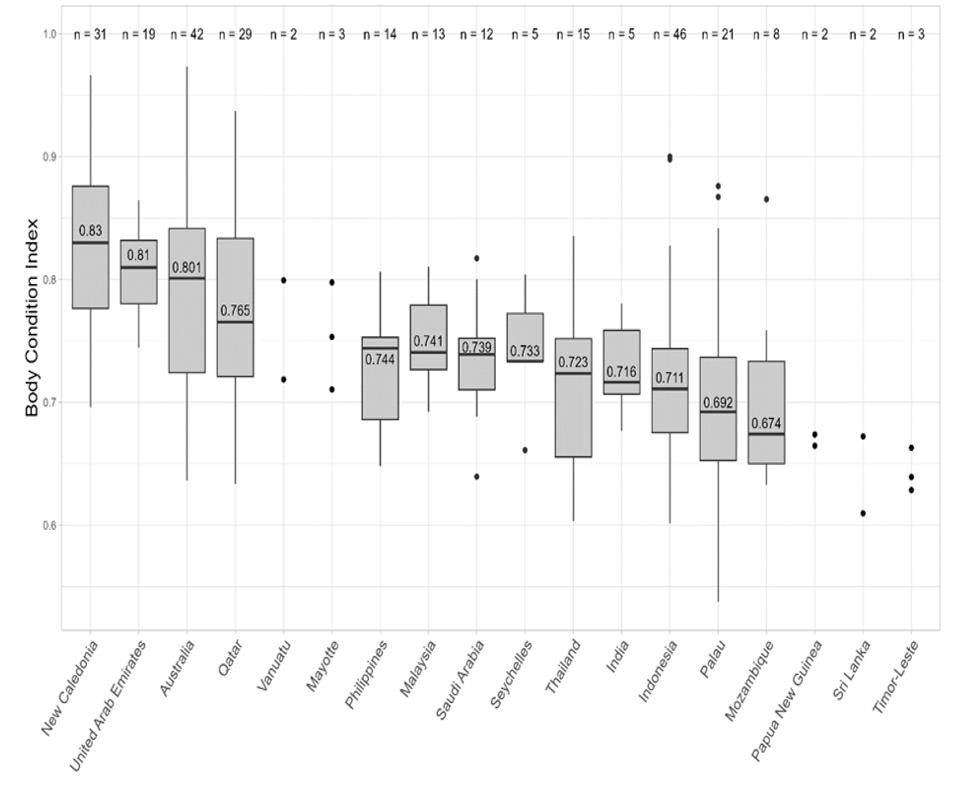
Variability of dugong body condition index across countries (n: number of individuals measured).
Then, using statistical models, they studied the effect of socioeconomic factors on dugong body condition. They found that wealthier areas are generally home to “plumper” dugongs, but that human pressures decrease the dugong’s condition. The presence of marine protected areas positively impacts the animals’ condition but extensive protection coverage is not sufficient to secure dugongs in good condition.
This study highlights the value of drones as a non-invasive tool for assessing the dugong’s body condition globally and spot population health issues earlier than traditional methods.
This international study was led by French Institut de Recherche pour le Développement at the MARBEC laboratory in collaboration with:
- Association Naturalistes Environnement et Patrimoine de Mayotte
- Red Sea Global and NEOM Nature Reserve in the Kingdom of Saudi Arabia
- Seychelles Islands Foundation in the Seychelles
- National Research and Innovation Agency in Indonesia within the ‘Sentinel Laboratory of the Indonesian Marine biodiversiTy’ (LMI SELAMAT)
- MareCet Research Organization in Malaysia
- Bazaruto Archipelago National Park in Mozambique
Researcher contact: Dr. Laura Mannocci [email protected]
URL of the paper: https://zslpublications.onlinelibrary.wiley.com/doi/10.1002/rse2.70016