
Celebrating World Seagrass Day: Restoring Vital Ecosystems for a Sustainable Future
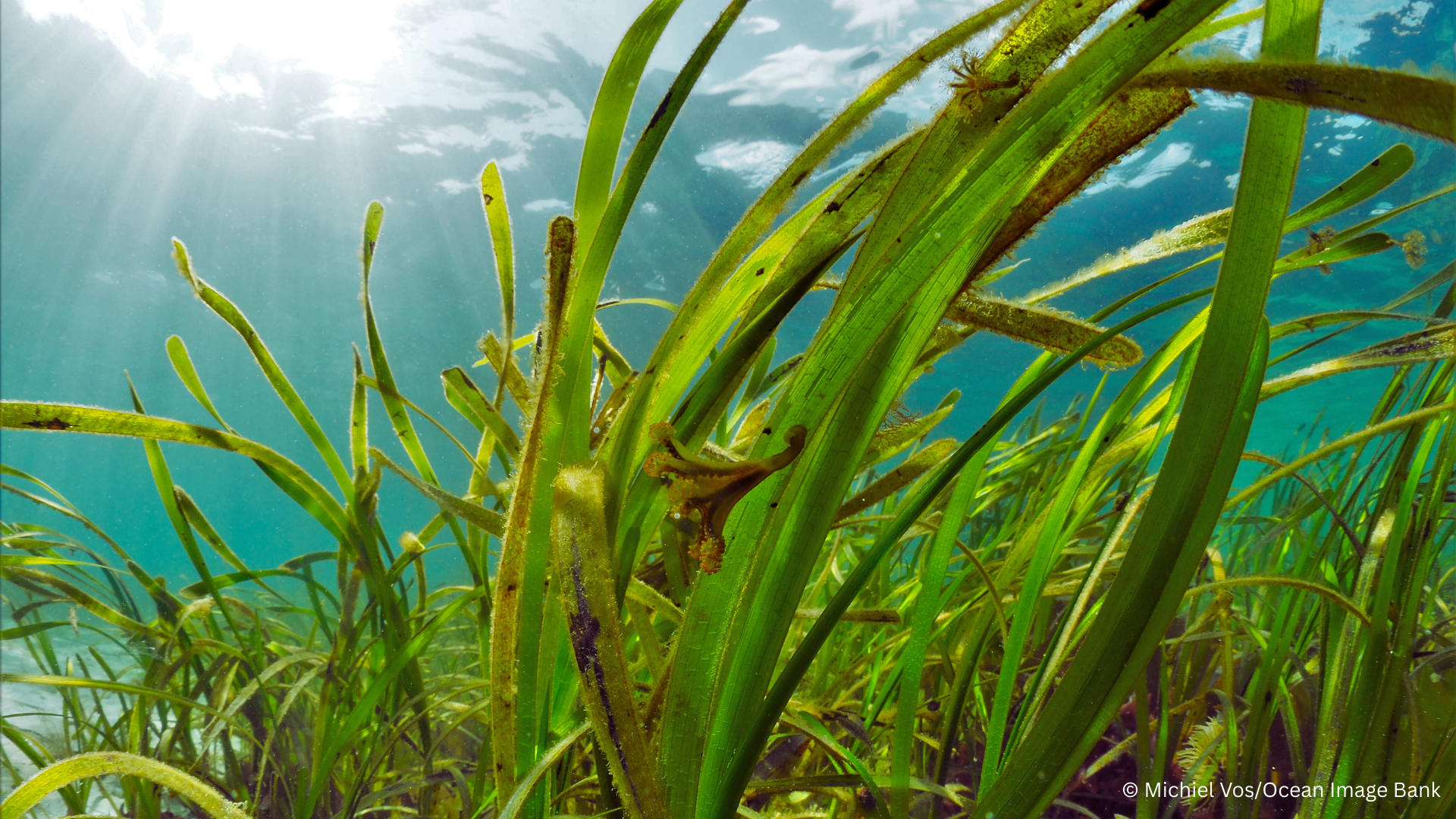
Cover photo: © Michiel Vos - Ocean Image Bank
In May 2022, the United Nations General Assembly proclaimed 1 March as World Seagrass Day, acknowledging the urgent need to raise awareness about the importance of seagrasses as a fundamental component of global biodiversity.
This international observance highlights the critical role of seagrass ecosystems, draws attention to the increasing threats they face, and encourages coordinated efforts to conserve and restore these vital marine habitats.
Seagrasses are unique marine flowering plants. Unlike seaweeds, they have true roots, stems, and leaves, and they reproduce through flowers and seeds. They grow in shallow coastal waters, forming dense underwater meadows found on six continents, from the tropics to near the Arctic circle.
Among the most widespread coastal habitats on Earth, seagrass meadows are essential to marine biodiversity, creating highly productive ecosystems that benefit both human and animal life.
Seagrass meadows provide shelter and nursery grounds for fish and invertebrates, protecting eggs, larvae and juveniles from predators and strong currents. A single acre of seagrass meadow can support up to 40,000 fish and 50 million small invertebrates. Without these nurseries, many species would struggle to reproduce, further accelerating global biodiversity loss.
Seagrasses also sustain vulnerable herbivorous migratory species listed under the Convention on the Conservation of Migratory Species of wild Animals. They are the exclusive primary food source of the dugong, and a critical feeding, foraging, and resting habitat for nearly 60% of the world’s sea turtle species during their migrations. Healthy seagrass meadows are therefore essential to the survival of these iconic marine animals.

Beyond biodiversity, these abundant habitats support approximately one-fifth of the world’s largest fisheries and provide subsistence and income for coastal communities. For many small-scale fishers, seagrass meadows are central to cultural heritage and identity, with traditional ecological knowledge passed down through generations. They also support recreation and ecotourism, offering opportunities for snorkeling and diving alongside charismatic wildlife such as dugongs and turtles.
For many coastal communities, seagrass meadows are not only ecological assets but living heritage - sustaining livelihoods, food security, and cultural identity across generations.
SEAGRASS AND CLIMATE ACTION
Seagrasses play a vital role in climate mitigation and adaptation. Although they cover only 0.1% of the ocean floor, they are estimated to store up to 18% of oceanic carbon, making them one of the planet’s most efficient natural carbon sinks. Their dense meadows trap and stabilize sediments, slow currents, and can reduce wave energy by up to 40%, helping to prevent coastal erosion and flooding.
By absorbing carbon dioxide, seagrasses can also buffer ocean acidification locally, improving water quality and enhancing the resilience of nearby ecosystems such as coral reefs.
AN ECOSYSTEM IN CRISIS
Despite their immense value, seagrass meadows are disappearing at an alarming rate - approximately 2% per year globally. Only about 26% of recorded seagrass meadows fall within marine protected areas. Losses are driven by climate change, agricultural and industrial pollution, land reclamation, coastal development, and unsustainable boating and fishing practices (Dunic et al., 2021).
These pressures are cumulative and often transboundary, requiring coordinated regional and global responses. Yet global monitoring remains limited, and measurable conservation targets are still emerging.
The 2030 Seagrass Breakthrough
In response to this urgent crisis, the 2030 Seagrass Breakthrough was developed to protect and restore over 16 million hectares of seagrass worldwide. Announced at COP28 by the Convention on the Conservation of Migratory Species of Wild Animals – Abu Dhabi Office in collaboration with the UN High-Level Climate Champions, the initiative provides a global framework for governments, organizations, and communities to act together at scale.
With seagrass in rapid decline, an estimated USD12 billion is needed by 2030 to halt losses, accelerate restoration, and achieve measurable conservation outcomes.

A CALL TO ACTION
On this World Seagrass Day, governments, research institutions, regional bodies, and financial partners are encouraged to scale up coordinated action to protect and restore seagrass ecosystems. This includes:
Integrating seagrass into national biodiversity and climate strategies
Strengthening monitoring and data systems
Investing in science-based restoration initiatives
Supporting enabling policies and sustainable financing mechanisms
Protecting seagrass is not merely an environmental imperative, it is a strategic investment in food security, coastal protection, climate stability, and the survival of migratory species that depend on these vital underwater habitats.
For more information, please visit:
https://www.dugongseagrass.org/projects/seagrass-breakthrough-2024-2030/