
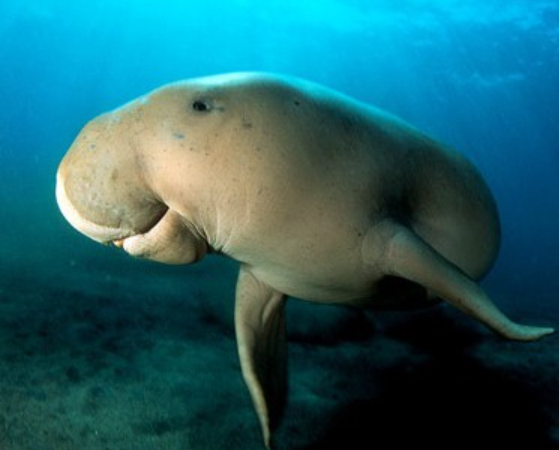
Dugong
Dugong dugon © NCCA Official, CC BY-NC-SA 2.0, via flickr.com
The dugong, the Amazonian manatee, West African manatee and West Indian manatee are the only surviving members of the Order Sirenia. Often referred to as sea cows, the closest relatives to the Sirenia are elephants and hyraxes. The dugong (Dugong dugon) is the only living member of the Family Dugongidae. Unlike manatees, dugongs have a whale-like fluked tail and a distinctive downturned snout that is specially adapted for feeding on seagrass growing on the seafloor.
As the only strictly marine herbivorous mammal, the dugong depends largely on seagrass for food and plays a unique role in maintaining seagrass meadows, making it an important indicator of healthy coastal ecosystems. The dugong's range extends to over 40 countries from East Africa to the Pacific. Australia is home to the largest remaining population of dugongs. Dugongs inhabit shallow coastal waters, including bays, lagoons, mangrove channels and reef flats where seagrass meadows occur. Their grazing helps maintain these important ecosystems, which support marine biodiversity, improve water quality, stabilize sediments and store significant amounts of blue carbon.
Dugongs are slow growing and can live for a long time. They can live for more than 70 years and have one of the slowest reproductive rates of any marine mammal. Females typically give birth to a single calf after a gestation of around 13–15 months and usually reproduce only every 3–7 years. They can grow up to three metres in length and weigh up to 500 kilograms. Although often seen alone or in small groups, dugongs may gather in larger herds where abundant seagrass is available.
The biological characteristics of dugongs make them highly vulnerable to threats. Dugongs are classified as "Vulnerable to Extinction" on the International Union for Conservation of Nature's (IUCN) Red List of Threatened Species, indicating that there is high risk of extinction in the wild in the medium-term future. CMS lists the dugong in its Appendix II, which means that international cooperative activities across jurisdictional boundaries within the dugong's migratory range are essential for the dugong's long-term survival. The greatest threats to dugongs include the loss and degradation of seagrass habitat, entanglement in fishing gear, vessel strikes, coastal development, pollution and the increasing impacts of climate change on seagrass meadows.
More information on dugongs can be found on our FAQ page and in the infographics What is the difference between dugongs and manatees? and What is the difference between seagrass and seaweed?